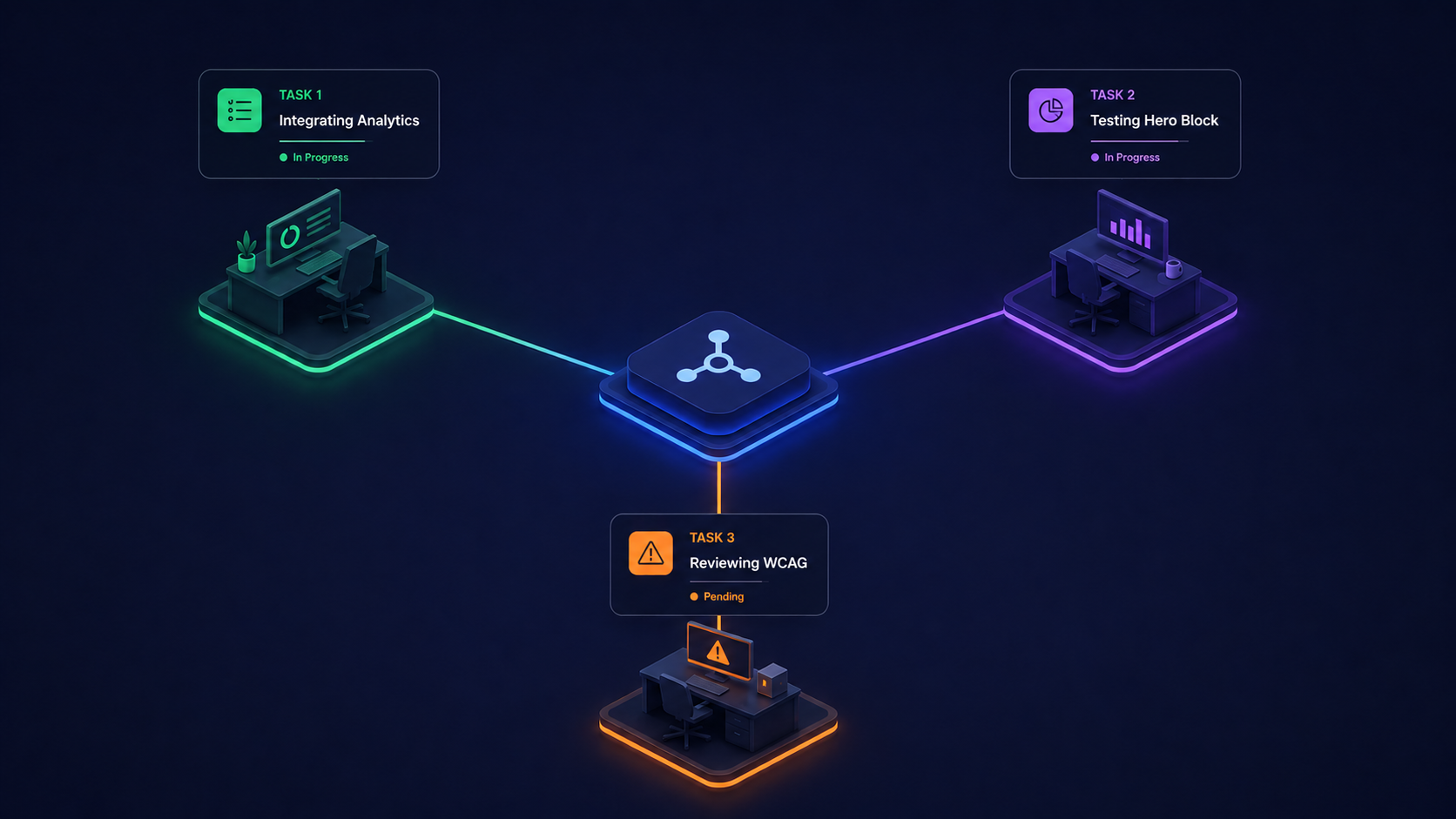
In 2026, the core AI question has moved past “What tool should we use?” to “How do all these tools work together to actually move the business?”
Where AI really is in 2026
- Most enterprises now report using generative AI in some form (McKinsey puts adoption at 78%), yet MIT’s NANDA initiative finds that 95% of GenAI pilots deliver no measurable P&L impact.
- Around three-quarters of knowledge workers now use AI at work, mostly for writing, analysis, and coding. But the savings tend to be small, scattered time wins that don’t roll up into visible business outcomes.
- AI is increasingly everywhere, but mostly as isolated helpers rather than coordinated teammates.
The three traps of disconnected AI
1. Shadow AI and risk you can’t see
- Employees adopt their own tools when official options lag: classic “shadow AI.” MIT’s research describes a “shadow AI economy” where only 40% of companies have official LLM subscriptions, but 90% of workers report daily use of personal AI tools for job tasks.
- Sensitive data can quietly flow into unapproved tools, expanding your attack surface and compliance risk.
2. Tool sprawl and the productivity paradox
- A growing share of enterprises report AI sprawl is limiting integration and governance. A recent Zapier survey found 70% of enterprises haven’t moved beyond basic AI integration, 14% have no visibility at all into what’s being used, and 76% have already taken at least one negative hit from disconnected AI.
- More tools ≠ more productivity. Without integration into real workflows, AI just adds more tabs, more context switching, and more cognitive load. HBR now calls this “AI fatigue”, and UC Berkeley researchers have documented “AI brain fry” tied to intensive oversight of AI systems.
3. Local wins, system-wide bottlenecks
- Individual tasks speed up, but core bottlenecks stay human: approvals, handoffs, exception handling, prioritization.
- The result: AI that feels impressive in demos but doesn’t shorten release cycles, improve customer journeys, or simplify operations.
A better mental model: AI as a system, not an app
To think clearly about AI in 2026, shift from “Which tool?” to “What system of work are we designing?”
Key questions:
-
Where does work really flow today? Map the end-to-end flow (requests → work → approvals → delivery) rather than only the tasks you want to “AI-ify.”
-
Which steps should be agentic? Agentic AI can monitor, decide, and act across systems, if you design for it. McKinsey’s late-2025 update frames this shift explicitly: leading companies now use agents to orchestrate multi-system workflows instead of only answering prompts.
-
How do humans stay in the loop? Redesign roles so humans supervise, correct, and handle nuance, instead of manually stitching tools together.
-
How will we measure impact? Time-to-resolution, cycle time, error rate, and employee experience matter more than “number of AI tools deployed.”
How United Logic thinks about AI in 2026
United Logic was built out of this exact problem: AI everywhere, but logic and workflows nowhere.
When we work with teams, we don’t start with “Which model?” We start with:
- Architecture first – Understand systems, data flows, and real-world work before adding agents.
- Agentic workflows, not AI widgets – Design agents that sit inside your stack, move work forward, and respect your governance.
- Trust by design – Observability, approvals, and clear boundaries so leaders can actually rely on AI-driven operations.
If your organization feels like it’s drowning in disconnected AI tools while real bottlenecks remain stubbornly human, you’re not alone, and you’re not stuck either. Share a bit about your current stack and workflows, and we’ll send back a focused view of where agentic, connected AI can actually move the needle for your business.